


Nine-Year-Old Becomes First Child in UK to Receive Groundbreaking Leg-Lengthening Implant
- by RNG247 , United Kingdom
- about 7 months ago
- 326 views
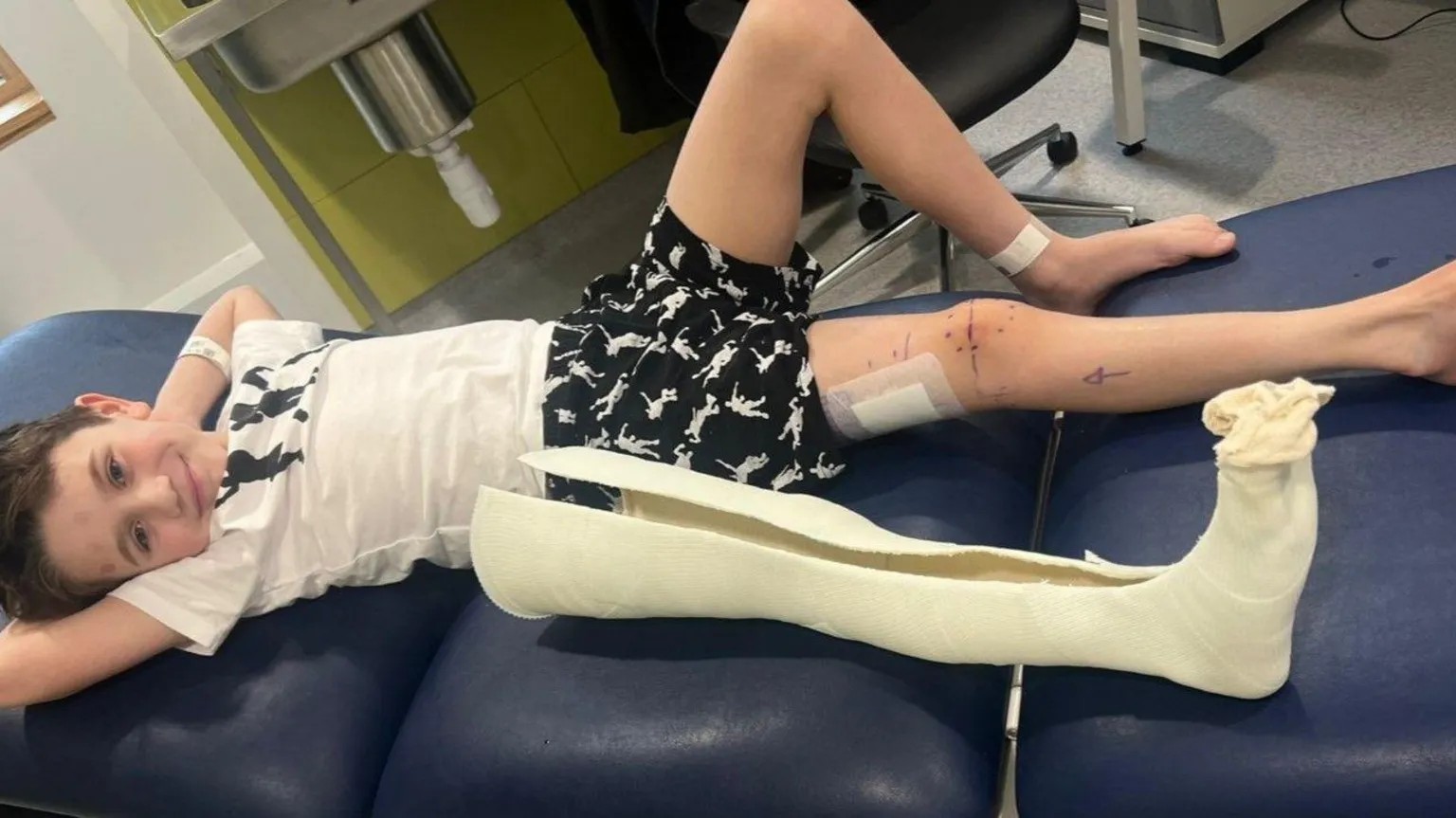
A nine-year-old boy from Northampton has become the first patient in the United Kingdom to receive a pioneering external-sparing leg-lengthening treatment that uses a magnetically activated telescopic nail placed on the surface of the femur.
Alfie Phillips, who was born with fibular hemimelia — a rare congenital condition that left his right leg more than an inch shorter than his left — underwent the operation at Alder Hey Children’s Hospital in Liverpool in March 2025. The procedure, performed by consultant orthopaedic surgeon Nick Peterson and his team, implanted a motorised telescopic nail on the outer surface of Alfie’s thigh bone rather than inside the growing bone itself, a modification intended to protect growth plates in young children.
“This technique allows internal lengthening with far less pain and a much better overall experience for children,” Peterson said. He described Alfie’s recovery as “remarkable” and said the case “paves the way for this technique to replace that old-fashioned way of doing things.”
Traditional intramedullary lengthening nails have been used in adults but were previously deemed unsuitable for younger patients because of the risk of damaging the growth plates that remain active through childhood. To avoid that risk, the Alder Hey team adopted a method developed in the United States that fixes the lengthening device extramedullarily — on the surface of the femur — while using an external magnetic controller to activate gradual distraction.
Following the short operation, Alfie spent less than a week in hospital. For roughly six weeks afterwards, a magnetic device was applied to his leg three times a day, each session initiating a tiny, controlled extension of about 1mm per day as the implant slowly pulled the two bone segments apart. The body responded by generating new bone tissue in the gap. Alfie attended weekly physiotherapy and clinical reviews throughout the lengthening phase and continued rehabilitation until the implant was removed three to four months later.
The team measured an initial gain of around 3cm (1.2in); specialists at Alder Hey say the current difference is about 4cm (1.6in) and project it could reach approximately 6cm (2.4in) by the time he reaches skeletal maturity around age 16. Peterson cautioned that Alfie may still need further lengthening to address the shin (tibial) discrepancy in future, but he emphasised that the experience and outcomes for a child of Alfie’s age have been “vastly superior” to what would previously have been possible.
Alfie, who said he felt both “excited” and scared to be the first child to undergo the procedure, reports a swift and joyful return to activity. “I can do a lot of the things I couldn’t do before like skipping, and now I am better at basketball and I can do trampolining, too,” he said. His mother, Laura Ducker, said her son “coped magnificently” and returned to school quickly. “He’s running around as normal — if you were to look at him you would never know that there had ever been anything happen,” she said.
Fibular hemimelia affects fewer than one in 40,000 births and commonly results in limb-length discrepancy, foot deformities and instability. The new surface-mounted magnetic lengthening approach offers clinicians an alternative that preserves growth plates while delivering the benefits of internal lengthening — namely reduced pain and lower infection risk compared with traditional external fixators.
Since Alfie’s operation, Alder Hey has performed the technique on three other children with fibular hemimelia, and several specialist centres across the UK are preparing to adopt the method. For families facing complex paediatric limb differences, clinicians say Alfie’s case marks a significant advance in options for safer, less intrusive correction at younger ages.












0 Comment(s)